
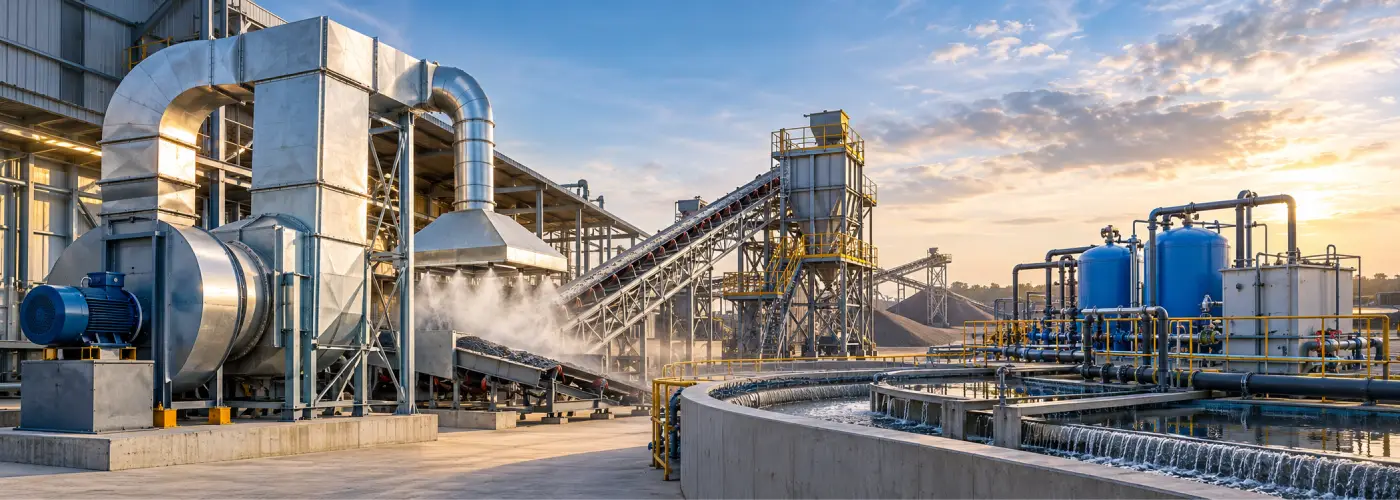
Air Washer UAF Systems Manufacturer
DSP Equipment is a specialized Air Washer UAF Systems Manufacturer providing engineered air-treatment and industrial ventilation solutions for customers across Kolkata, Bihar, Jharkhand, Odisha, Chhattisgarh and Assam. Our systems are developed for applications where large-volume air movement, evaporative cooling, air washing and controlled environmental conditions are required.
An Air Washer Unit (AWU) uses water contact with an air stream to support cooling and air treatment, while a UAF (Unit Air Filter / UAF ventilation arrangement, depending on project terminology) can be configured as part of a larger industrial air-handling system. Industrial specifications can include fans, pumps, filters, spray sections, eliminators, louvers, dampers and control instrumentation. Large power and process projects may use air-washer and UAF systems with very high airflow capacities.
Product Overview
Air Washer UAF Systems are designed for industrial facilities where ordinary room air circulation is not sufficient to meet the required cooling or air-quality conditions.
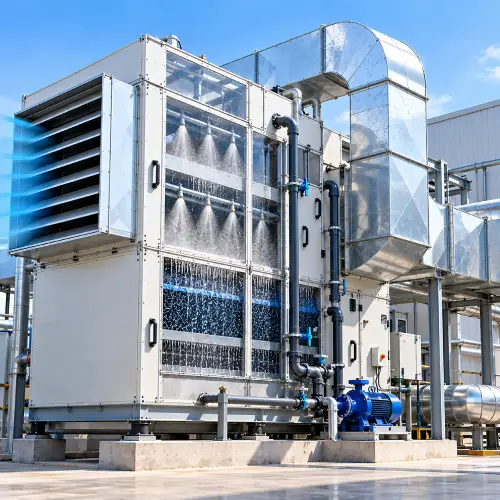
The air washer section brings air into contact with circulating water. Depending on the design, this process can provide evaporative cooling and assist in removing certain airborne particulate matter. Air washers are also used as part of larger air-handling arrangements where temperature, humidity and air cleanliness need to be managed.
A typical industrial arrangement may incorporate:
- Fresh-air inlet louvers
- Filter section
- Air washer chamber
- Spray nozzles
- Water circulation pump
- Water tank or sump
- Cooling media, where specified
- Mist or drift eliminators
- Centrifugal fan
- Motor and drive arrangement
- Outlet damper
- Duct connection
- Pressure gauges
- Differential-pressure monitoring
- Level-control arrangement
- Local control panel
- Automatic or manual operating controls
The actual configuration is selected according to the required airflow, static pressure, cooling objective, installation environment and process conditions.
Why Air Washer UAF Technology Is Used in Industrial Facilities
Industrial buildings can have substantial internal heat loads because of machinery, electrical equipment, production processes and large enclosed spaces. In such situations, the ventilation system needs to move considerable quantities of air while addressing the thermal conditions of the facility.
Air washer technology can provide a practical method of cooling incoming or recirculated air through water-based evaporative cooling. Where properly engineered, this can be integrated into large industrial air-handling systems.
- Large-Volume Air Movement
Industrial air washer systems can be engineered for substantial airflow requirements, making them suitable for large production and utility buildings.
- Evaporative Cooling
Water evaporation can reduce the temperature of the air stream under suitable ambient conditions.
- Air Washing
Water contact can assist in removing some particulate matter from the air stream, depending on the system design and contaminant characteristics.
- Integrated Filtration
Filter sections can be incorporated before or after the air-washing stage according to the required air-treatment arrangement.
- Controlled Water Circulation
A dedicated pump and water circuit maintain the required water flow through the spray or washing section.
- Mist Elimination
Eliminator sections can help reduce water carryover from the air stream into downstream ductwork.
- Industrial-Scale Configuration
The equipment can be engineered according to large airflow and static-pressure requirements rather than being limited to small comfort-cooling applications.
Technical Specifications
Air Washer UAF systems should be engineered according to the individual project. Typical parameters considered during equipment selection include:
Parameter | Design Consideration |
System Type | Industrial Air Washer / UAF System |
Airflow Capacity | Selected according to building and process requirement |
Fan Type | Centrifugal or other suitable configuration |
Fan Static Pressure | Determined from total system resistance |
Air Washing Section | Spray/nozzle or media-based arrangement |
Filtration | Pre-filter / suitable filter arrangement |
Eliminator | Suitable drift or mist eliminator |
Water Circulation | Pump-based recirculation |
Water Tank | Sized according to operating requirement |
Spray Pressure | Based on nozzle and water-circulation design |
Casing | MS/GI/SS or other project-specific construction |
Insulation | Provided where thermal requirements demand |
Control | Local / automatic / integrated control panel |
Pressure Monitoring | Pressure gauge or differential-pressure instrument |
Level Control | Level switch/sensor as required |
Damper | Manual or motorized |
Motor | Selected according to fan duty |
Drive | Direct or belt-driven according to application |
Installation | Floor, rooftop or dedicated equipment area |
Operating Mode | Continuous/intermittent as required |
As an example of the wide range possible in industrial projects, published power-sector specifications have included UAF airflow of 100,000 CMH and fan static pressure of 60 mm WG, while other project specifications use different capacities and pressure drops. These figures should therefore not be treated as a standard DSP Equipment rating; final values must be established from the project design.
Engineering the Air-Water Interaction
The air washer section is one of the most important parts of the system. Its performance depends on the interaction between airflow and water distribution.
DSP Equipment considers factors such as:
- Air velocity through the washing section
- Water circulation rate
- Spray arrangement
- Nozzle distribution
- Contact area
- Eliminator efficiency
- Air-side pressure drop
- Water quality
- Drainage requirements
- Required cooling effect
A properly arranged spray chamber should distribute water effectively across the air passage while minimising unwanted water carryover.
Fan and Static Pressure Selection
The fan is not selected solely from the required airflow. It must also overcome resistance generated by the complete air path.
Pressure losses may arise from:
- Inlet louvers
- Filters
- Air washer chamber
- Spray section
- Eliminators
- Dampers
- Ductwork
- Bends
- Grilles
- Other downstream components
Therefore, the required fan duty should be established from the combined airflow and system-resistance calculation. Industrial specifications demonstrate that these individual pressure-drop components may be separately considered during fan selection.
Water Circulation and Pump Arrangement
The water circuit is essential to an air washer system. The circulation pump supplies water to the spray arrangement, where it comes into contact with the moving air stream.
The water system may include:
- Circulation pump
- Suction arrangement
- Spray header
- Spray nozzles
- Tank/sump
- Strainer
- Level switch
- Drain connection
- Overflow arrangement
- Make-up water connection
- Isolation valves
Where required, working and standby pump arrangements can also be considered for critical industrial installations. Project specifications may incorporate pump and fan interlocks so that the water circuit operates in coordination with the air-moving equipment.
Infrastructure and Industrial Uses of Air Washer UAF Systems
Air Washer UAF systems can become an important part of the mechanical infrastructure of large industrial facilities.
They may be used for:
- 1. Production-hall cooling
- 2. Industrial ventilation
- 3. Equipment-room air management
- 4. Power plant ventilation
- 5. Process-area cooling
- 6. Utility building ventilation
- 7. Workshop air circulation
- 8. High-volume fresh-air supply
- 9. Heat-load management
- 10. Industrial air treatment
- 11. Large enclosed manufacturing areas
- 12. Auxiliary plant buildings
For large facilities, the system can also be coordinated with duct networks, electrical controls, building ventilation and other HVAC equipment.
Air Filtration and Eliminator Arrangement
The filtration section helps manage particulate matter entering the air-handling equipment. Filter selection depends on the surrounding environment and the required cleanliness level.
Following the washing section, an eliminator arrangement can help capture entrained water droplets before the conditioned air enters the downstream duct system.
This combination can be particularly useful in industrial environments where the system must simultaneously address:
Air Intake → Filtration → Water Contact → Cooling → Droplet Separation → Fan → Conditioned Air Distribution
Common Applications
- Power Generation Facilities
Large power plants may require high-capacity air-handling and ventilation systems for turbine halls, electrical buildings, auxiliary areas and other utility spaces.
- Steel and Metal Industries
Large manufacturing environments can generate significant heat, making high-volume air movement an important part of environmental management.
- Cement and Mineral Processing
Dust-producing industrial operations can require carefully designed air-treatment and ventilation arrangements.
- Heavy Engineering Plants
Large production halls with machinery and process equipment may require industrial-scale air circulation and cooling.
- Textile Manufacturing
Textile plants can have specific temperature and humidity requirements. Air washer systems are widely used in industrial air-treatment applications where humidity and evaporative cooling are relevant.
- Food Processing Facilities
Controlled air conditions can be important in processing and production areas, subject to the specific hygiene and process requirements.
- Large Industrial Workshops
High-volume ventilation and cooling can help manage heat accumulation in enclosed production areas.
- Utility and Equipment Buildings
Air washer and UAF arrangements can be considered for large technical buildings where conventional comfort air-conditioning may not be the appropriate primary solution.
Quality You Can Trust
DSP Equipment approaches Air Washer UAF systems as complete engineered equipment rather than simply assembling a fan, pump and water chamber.
- Robust Equipment Construction
The casing and internal sections can be selected according to the environmental and operational conditions of the installation.
- Balanced Airflow Design
Fan selection is matched with the expected system resistance to achieve the required airflow.
- Reliable Water Distribution
The spray arrangement is designed to provide effective water distribution throughout the intended air-contact area.
- Reduced Water Carryover
Suitable eliminator sections can be incorporated to limit moisture carryover into the downstream air path.
- Practical Maintenance Access
Inspection and maintenance provisions can be considered for filters, pumps, spray sections, tanks and fan assemblies.
- Application-Specific Controls
Level switches, pressure instruments, motor interlocks and other controls can be integrated according to project requirements. Industrial specifications commonly use such interlocks and monitoring devices for coordinated fan and pump operation.
Why Choose this company?
- Designed for the Actual Duty
DSP Equipment does not treat airflow capacity as the only selection parameter. Fan pressure, filtration, water circulation and air-side resistance are also considered.
- Industrial Project Orientation
Our systems are intended for applications where equipment must operate under demanding industrial conditions.
- Custom Configuration
Air washer UAF systems can be configured around the required airflow, installation space, construction material and operating conditions.
- Complete System Coordination
Fan, pump, filter, eliminator, controls, duct connections and water-management components are considered as interconnected parts of the system.
- Suitable for Large Facilities
The design approach can be adapted to high-airflow industrial installations where substantial air volumes need to be moved.
Service Coverage
DSP Equipment serves customers across:
- Kolkata
- Bihar
- Jharkhand
- Odisha
- Chhattisgarh
- Assam
Frequently Asked Questions
It is an industrial air-treatment and ventilation arrangement combining air movement with filtration and water-based air washing/cooling. The exact meaning and configuration of “UAF” can vary by project specification, so the equipment should be defined according to the project documents.
No. An air washer generally uses water-based air treatment and evaporative cooling, whereas conventional air-conditioning typically uses a refrigeration cycle or chilled-water system. Air washers can be suitable for applications where evaporative cooling is appropriate.
Yes. Industrial projects can use very high-capacity air washer and UAF systems. Published project specifications demonstrate capacities reaching 100,000 CMH and beyond, depending on the installation.
Important information includes required airflow, static pressure, room/building dimensions, ambient conditions, desired temperature, application, installation location, filtration requirement and available electrical power.
Air washer systems using a recirculating water spray arrangement normally require a pump to circulate water through the spray system.
Yes. For critical installations, working/standby arrangements and automatic interlocks can be incorporated according to project requirements.
DSP Equipment provides solutions across Kolkata, Bihar, Jharkhand, Odisha, Chhattisgarh and Assam.
Contact DSP Equipment
For an Air Washer UAF Systems Manufacturer for your industrial or commercial project, contact DSP Equipment with your technical requirement.
To help determine the appropriate configuration, provide details such as:
- Required airflow in CFM or CMH
- Required static pressure
- Building/room dimensions
- Application
- Ambient conditions
- Required cooling performance
- Filtration requirement
- Installation location
- Available electrical supply
- Water availability
- Ducting details, if available
DSP Equipment can discuss your requirement and provide an application-oriented solution for projects across Kolkata, Bihar, Jharkhand, Odisha, Chhattisgarh and Assam.
Contact us today for Air Washer UAF System enquiries, industrial project requirements, bulk orders and competitive quotations.