
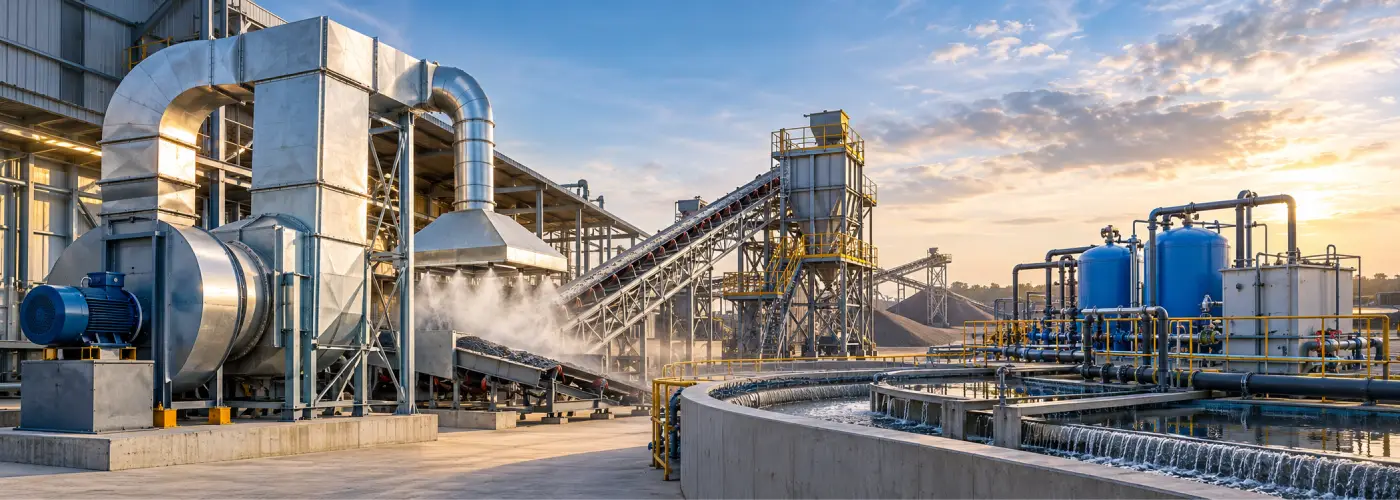
Dual Fluid Fog Type Dust Suppression Systems Manufacturer
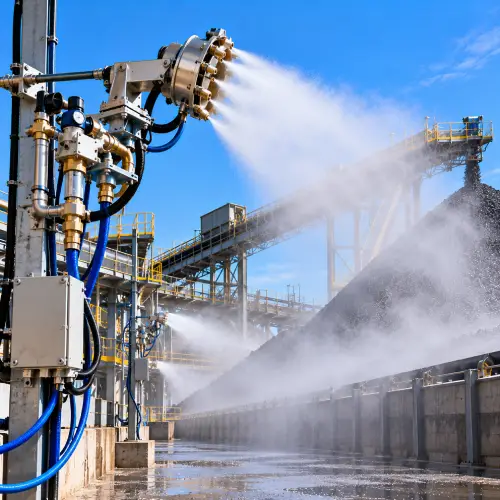
DSP Equipment is a manufacturer of Dual Fluid Fog Type Dust Suppression Systems for industries dealing with fine, fugitive and process-generated dust. The system uses a combination of water and compressed air to create a fine fog that can be directed toward dust-emission points.
The fine droplets are designed to interact with airborne dust particles, helping bring them down and limiting their movement into the surrounding work environment. Compared with conventional water sprinkling, dual-fluid fog technology can provide finer atomization with controlled water consumption, making it suitable for selected material-handling and processing applications. DSP Equipment develops application-specific systems for industrial plants across Kolkata, Bihar, Jharkhand, Odisha, Chhattisgarh and Assam.
How DSP Equipment’s Dual Fluid Fog System Controls Dust
The effectiveness of a dual-fluid system depends on delivering the fog close to the location where dust becomes airborne.
- Water Preparation
Water is supplied to the fog system through the designated water line or pumping arrangement.
- Compressed-Air Supply
Compressed air is supplied to the atomising nozzles to assist in breaking the water into fine droplets.
- Fine Fog Generation
The specially selected dual-fluid nozzles combine water and compressed air to generate a fine fog.
- Targeted Application
The nozzles are positioned around the dust-emission point so that the fog reaches the required zone.
- Dust Particle Interaction
Fine droplets come into contact with suspended dust particles, increasing their effective mass and encouraging them to settle.
- Controlled Operation
The system can be arranged in separate sections so that fogging is activated where and when the corresponding process equipment is operating.
What Is a Dual Fluid Fog Type Dust Suppression System?
A Dual Fluid Fog Dust Suppression System combines two operating media:
- Water
- Compressed air
These are supplied to specially design atomising nozzles. The interaction between air and water produces a fine mist or fog, which is discharged toward the dust-generating zone. The system is particularly useful where dust needs to be controlled without simply flooding the material with large quantities of water. Depending on the process, the fog arrangement can be installed at transfer points, crushers, screens, hoppers, feeders, discharge locations and other areas where airborne dust is generated.
How DSP Equipment’s Dual Fluid Fog System Controls Dust
The effectiveness of a dual-fluid system depends on delivering the fog close to the location where dust becomes airborne.
- Water Preparation
Water is supplied to the fog system through the designated water line or pumping arrangement.
- Compressed-Air Supply
Compressed air is supplied to the atomising nozzles to assist in breaking the water into fine droplets.
- Fine Fog Generation
The specially selected dual-fluid nozzles combine water and compressed air to generate a fine fog.
- Targeted Application
The nozzles are positioned around the dust-emission point so that the fog reaches the required zone.
- Dust Particle Interaction
Fine droplets come into contact with suspended dust particles, increasing their effective mass and encouraging them to settle.
- Controlled Operation
The system can be arranged in separate sections so that fogging is activated where and when the corresponding process equipment is operating.
Where Dual Fluid Fog Dust Suppression Works Best
Rather than treating an entire plant with water, dual-fluid fog systems are generally configured around specific dust-generation sources.
- Conveyor Transfer Points
Material falling from one conveyor to another can create a sudden release of fine dust. Fog nozzles can be positioned around the transfer zone.
- Crusher Feed & Discharge
Crushing operations can generate significant quantities of airborne particulate matter. A suitably designed fog arrangement can be directed toward the relevant emission points.
- Screening Plants
Fine particles released during screening can be addressed by installing fogging points around suitable sections of the screening arrangement.
- Hoppers and Feeders
Material dropping into or moving through hoppers and feeders can produce dust. Targeted fogging can be incorporated around the loading or discharge area.
- Wagon & Truck Loading Areas
For selected bulk-material loading operations, fogging can be used around the point where material enters or leaves transport equipment.
- Stockyard Material Handling
The system can be configured for selected material movement areas in stockyards where fine dust becomes airborne during handling.
Designed for Fine Dust at Material Transfer Locations
One of the important considerations in industrial dust control is where the dust actually becomes airborne. DSP Equipment focuses on locating fog nozzles as close as practical to the dust-generation source. The objective is to create an effective fog zone without unnecessarily increasing water application throughout the facility.
The final nozzle arrangement can depend on:
- Particle size
- Material characteristics
- Material drop height
- Conveyor capacity
- Belt speed
- Dust generation rate
- Air movement
- Available water pressure
- Compressed-air pressure
- Available installation space
- Required fog coverage
Why Dual Fluid Fog Instead of Conventional Water Spraying?
Conventional sprinkling systems generally apply comparatively larger water droplets over an area. A dual-fluid arrangement uses compressed air to atomise water into a much finer fog.
This distinction can be useful when:
- Fine airborne dust needs targeted treatment
- Excessive material wetting should be avoided
- The dust source is concentrated
- Water availability needs to be controlled
- Fogging needs to be directed into an enclosed transfer point
- Automatic zone control is required
The choice between plain-water sprinkling, dry fog, dual-fluid fog and other dust-control technologies should be based on the material, process, dust characteristics and permissible moisture addition.
Dual Fluid Fog System – Technical Configuration
Component / Parameter | Typical Arrangement |
System Type | Dual Fluid Fog Dust Suppression |
Suppression Media | Water + Compressed Air |
Atomisation | Pneumatic / Dual Fluid Nozzle |
Water Supply | Pump / Plant Water Network |
Air Supply | Plant Compressor / Dedicated Compressor |
Fog Generation | Fine Atomised Droplets |
Nozzle Material | Selected according to application |
Control | Manual / Automatic / PLC-Based |
Installation | Indoor / Outdoor |
Application | Point-Based Dust Suppression |
Pipeline | Industrial-grade piping |
Water Filtration | As required |
Air Filtration | As required |
Solenoid / Control Valves | Application dependent |
Number of Nozzles | Based on dust source and coverage |
Water Consumption | Application dependent |
Air Consumption | Application dependent |
System Layout | Custom Engineered |
Important: There is no single nozzle quantity, water flow or air pressure suitable for every plant. DSP Equipment can determine the operating parameters based on the dust source and process conditions.
Key Advantages of Dual Fluid Fog Dust Suppression
- Fine Atomisation
Compressed air assists in producing smaller water droplets than conventional coarse spraying arrangements.
- Lower Unnecessary Wetting
Targeted fog application can reduce excessive wetting where large-volume water spraying is undesirable.
- Suitable for Point-Source Dust
The system can be concentrated around specific transfer, loading, crushing or screening locations.
- Flexible Nozzle Positioning
Nozzles can be arranged according to the geometry of the equipment and the direction of material movement.
- Section-Wise Operation
Different dust-generating zones can be operated independently when appropriate controls are incorporated.
- Suitable for Existing Plants
A properly engineered arrangement can be incorporated into many existing material-handling facilities without replacing the complete process line.
- Automated Control Possibility
The fog system can be connected with suitable sensors, valves, timers or PLC-based controls according to the project requirement.
Applications of Dual Fluid Fog Dust Suppression Systems
DSP Equipment’s systems can be considered for:
- Coal handling plants
- Thermal power plants
- Steel manufacturing plants
- Cement industries
- Mining operations
- Mineral processing units
- Iron ore handling
- Coal transfer systems
- Stone crushing plants
- Aggregate plants
- Screening plants
- Conveyor galleries
- Material transfer stations
- Hoppers
- Feeders
- Crushers
- Stockyards
- Loading and unloading points
- Bulk material handling facilities
Components Used in a Dual Fluid Fog System
A complete installation can include a combination of:
- Water Pumping Unit
Provides the required water supply to the fogging network. - Air Supply System
Provides compressed air needed for atomisation. - Dual-Fluid Nozzles
The primary fog-generation components that combine water and air. - Water & Air Piping
Separate distribution arrangements carry the two media to the required locations. - Filters
Help protect the nozzles from contaminants that could affect spray performance. - Control Valves
Allow individual fogging sections to be isolated or operated. - Solenoid Valves
Can be incorporated where automated opening and closing is required. - Control Panel
Suitable controls can be provided for coordinated system operation.
Custom Engineering for Different Industrial Layouts
Every material-handling plant has different equipment dimensions, conveyor arrangements and dust-emission points. For this reason, DSP Equipment can develop the fog system around the existing process layout.
The engineering approach may include:
Dust Source Identification → Equipment Study → Nozzle Positioning → Water & Air Network Design → Control Arrangement → Installation Support
This helps create a system that addresses the actual operating conditions rather than relying on a standard off-the-shelf configuration.
Dual Fluid Fog Dust Suppression System Manufacturer in Kolkata
DSP Equipment manufactures Dual Fluid Fog Type Dust Suppression Systems in Kolkata for industrial dust-control applications. Solutions can be developed for conveyor transfer points, crushers, screening equipment, hoppers, feeders and other bulk-material handling locations.
Dual Fluid Fog Dust Suppression System Supplier in Bihar & Jharkhand
Industries in Bihar and Jharkhand can source application-specific dual-fluid fog dust suppression solutions from DSP Equipment for mining, coal handling, power, steel, mineral processing and other industrial operations.
Dual Fluid Fog Dust Suppression System in Odisha & Chhattisgarh
DSP Equipment provides Dual Fluid Fog Type Dust Suppression Systems in Odisha and Chhattisgarh for suitable applications in mining, steel, power generation, cement, aggregates and bulk-material handling facilities.
Dual Fluid Fog Dust Suppression System in Assam
For industrial projects in Assam, DSP Equipment offers dual-fluid fogging solutions designed around specific dust-generating locations and plant operating conditions.
Quality, Reliability & Practical Maintenance
A dust suppression system must continue performing under demanding industrial conditions. DSP Equipment therefore considers component accessibility and maintenance requirements while developing the system.
Important considerations include:
- Easy nozzle inspection
- Accessible filters
- Proper pipe routing
- Isolation of individual sections
- Protection against nozzle blockage
- Suitable valve arrangement
- Convenient maintenance access
- Robust installation practices
Regular inspection of nozzles, filters, water quality, air supply and control components is important for maintaining consistent fog performance.
Why Industries Choose DSP Equipment
- Application-Specific Design
Systems are developed around the customer’s dust source and process requirements.
- Dual-Media Engineering
Water and compressed-air distribution are considered together to achieve the required atomisation arrangement.
- Industrial Applications
The equipment can be configured for demanding bulk-material handling environments.
- Custom Nozzle Arrangement
Nozzle quantity and positioning can be planned according to the equipment layout.
- Flexible Automation
Manual, semi-automatic or PLC-integrated operation can be considered depending on the project.
- Regional Service Coverage
DSP Equipment serves customers across Kolkata, Bihar, Jharkhand, Odisha, Chhattisgarh and Assam.
Frequently Asked Questions
It is a dust-control system that uses water and compressed air together to produce a fine fog for targeted suppression of airborne dust.
Yes. Compressed air is one of the two operating media used to atomise the water through the dual-fluid nozzle.
They can be installed at suitable dust-generation locations such as conveyor transfer points, crushers, screens, hoppers, feeders and loading areas.
It can be suitable for selected coal-handling applications, particularly where targeted fogging is required at material transfer and handling points. The final design depends on the process and material conditions.
Yes. Suitable valves, controls, sensors and PLC interfaces can be incorporated depending on the required operating sequence.
Yes. DSP Equipment can develop the water network, compressed-air arrangement, nozzle configuration and control system according to the application.
Get a Dual Fluid Fog Dust Suppression System Quote
If you are looking for a Dual Fluid Fog Type Dust Suppression Systems Manufacturer in Kolkata, Bihar, Jharkhand, Odisha, Chhattisgarh & Assam, contact DSP Equipment for an application-specific solution.Share your plant layout, dust-generating equipment, material type, conveyor capacity and available water/air details to discuss a suitable system configuration and obtain a project quotation.