
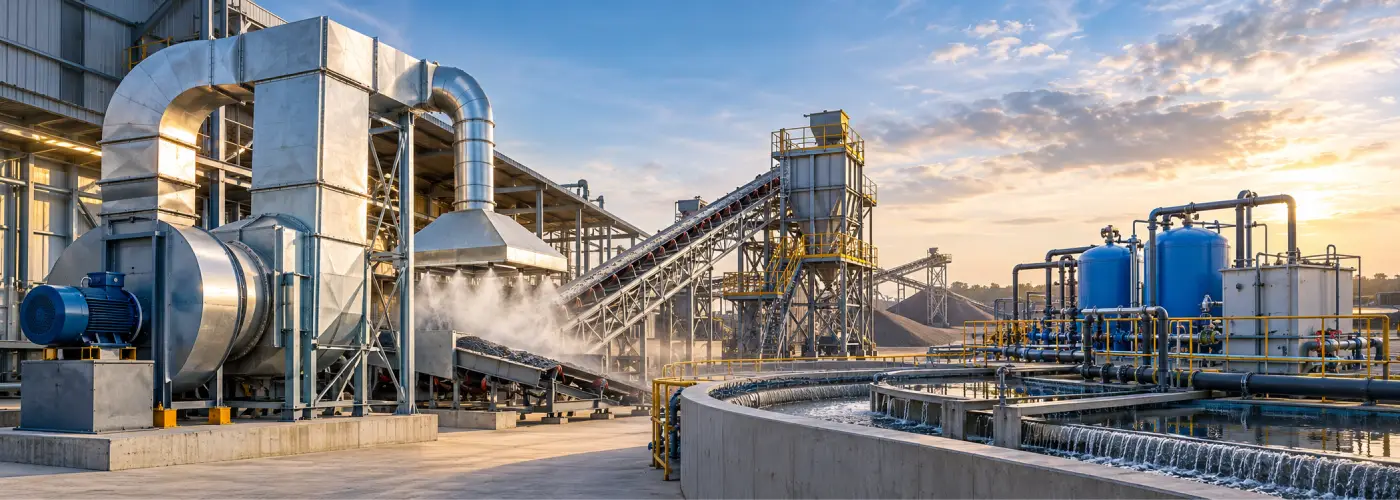
Dry Type Dust Extraction Systems Manufacturer
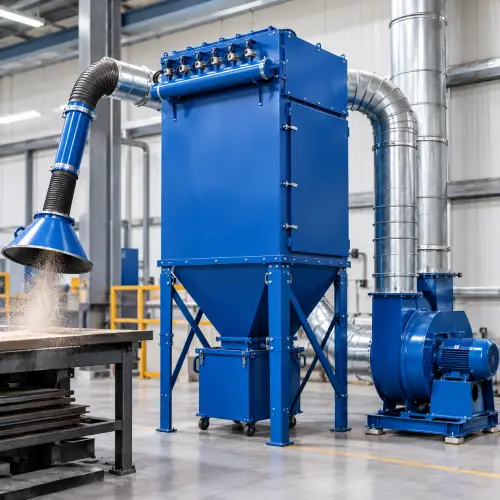
DSP Equipment provides industrial Dry Type Dust Extraction Systems for controlling airborne dust generated during manufacturing, processing, grinding, cutting, crushing, conveying and material-handling operations. Dry collectors generally use filtration media such as fabric bags or pleated cartridges to separate particulate matter from the extracted air.
Designed around the actual process conditions, these systems can be configured as centralised or point-source extraction arrangements for different industrial environments. DSP Equipment serves customers looking for reliable dry dust extraction solutions in Kolkata, Bihar, Jharkhand, Odisha, Chhattisgarh & Assam.
Product Overview
A Dry Type Dust Extraction System captures dust-laden air directly from the generation point and transfers it through a network of ducts to a dry filtration unit. The filtration section separates particulate matter from the air stream, while the collected dust is discharged through a hopper, rotary valve, dust bin or another suitable arrangement.
Depending on the application, DSP Equipment can develop systems incorporating pulse jet bag filters, cartridge filters, cyclone pre-separators and customised dry filtration assemblies. Baghouse systems are commonly used for heavier dust loads and larger process air volumes, while cartridge collectors can provide a compact solution for many fine and dry dust applications.
The complete arrangement can include:
- Suction hoods and pickup points
- Industrial ducting
- Filter housing
- Filter bags or cartridges
- Pulse-jet cleaning arrangement
- Dust collection hopper
- Rotary airlock or discharge mechanism
- ID/centrifugal fan
- Control panel
- Access platforms and maintenance provisions
What Makes Dry Dust Extraction Different?
Unlike wet collection methods, a dry dust extraction system does not introduce water into the collected dust stream. This can be particularly useful when the recovered material needs to remain dry for reuse, recycling or controlled disposal.
The filtration process also allows the system to be designed around specific air volume, particle size, dust loading, temperature and available installation space rather than using one standard configuration for every plant.
Important Design Considerations
- Dust particle characteristics
- Dust concentration at the pickup point
- Required extraction airflow
- Filter media selection
- Operating temperature
- Pressure-drop requirements
- Duct velocity
- Available floor area and installation height
- Dust discharge method
- Maintenance accessibility
System Configurations Available
- Pulse Jet Bag Filter System
A pulse jet baghouse uses fabric filter bags supported by cages. Dust accumulates on the filter surface and is periodically removed using compressed-air pulses, allowing the filtration process to continue during automatic cleaning.
- Cartridge Dust Collector
Cartridge systems use pleated filter elements that provide a large filtration surface within a comparatively compact housing. They are commonly considered for fine, dry particulate and applications where equipment footprint is an important consideration.
- Cyclone Pre-Separator
A cyclone can be incorporated ahead of the final filter to remove larger or heavier particles and reduce the dust burden reaching the downstream filtration stage.
- Centralised Extraction System
Multiple machines or production points can be connected through a common ducting network to one appropriately sized dust collection unit.
Technical Specifications
Specification | Typical Design Range / Configuration |
System Type | Dry Industrial Dust Extraction System |
Filtration Technology | Bag Filter / Cartridge / Cyclone + Filter |
Filter Cleaning | Pulse Jet / Shaker / Application-Specific |
Filter Media | Polyester, Synthetic, Cellulose or Specialised Media |
Airflow | Engineered according to process requirement |
Dust Loading | Application-dependent |
Operating Temperature | Based on selected filter media |
Dust Discharge | Hopper / Rotary Valve / Dust Bin |
Fan Type | Centrifugal / Industrial Exhaust Fan |
Duct Material | MS / SS / Application-Specific |
Housing Material | MS / SS as required |
Control | Manual / Automatic Control Panel |
Installation | Indoor / Outdoor |
Configuration | Individual Machine / Centralised System |
Filter Area | Selected according to air-to-cloth or filtration requirements |
Final specifications are determined from the actual process data. Filter selection and filtration area should be matched to airflow, dust loading, temperature and material characteristics.
Industrial Applications
Dry dust extraction technology can be incorporated into numerous dust-generating operations, including:
- Grinding & Polishing Units – Extraction of particulate generated during surface finishing.
- Cement & Building Material Plants – Collection from material transfer and processing points.
- Foundries – Dust extraction from selected moulding, fettling and material-handling operations.
- Metal Fabrication – Extraction from cutting, grinding and finishing processes.
- Woodworking Units – Collection of dry wood dust and chips with appropriately designed equipment.
- Pharmaceutical Plants – Dry powder extraction from suitable process areas.
- Chemical Industries – Collection of compatible dry particulate and powders.
- Mineral Processing Plants – Extraction from crushing, screening and conveying points.
- Ceramic & Refractory Industries – Control of dust generated during material preparation.
- Food & Powder Processing – Suitable dry-powder extraction arrangements based on product characteristics.
Cartridge and baghouse collectors are widely used across manufacturing, mineral processing, chemical, pharmaceutical, woodworking and other industries, with the collector type selected according to the dust and process conditions.
Engineering & Construction Quality
DSP Equipment approaches dry dust extraction as a complete air-handling system, rather than treating the collector as an isolated machine. Properly positioned suction points, appropriately sized ductwork and a correctly selected filtration section are important for maintaining effective capture at the dust source.
The equipment can be engineered with attention to:
- Strong structural framework
- Properly sealed filter housing
- Accessible inspection doors
- Replaceable filter elements
- Automatic filter cleaning
- Suitable dust discharge arrangements
- Fan and motor compatibility
- Easy maintenance access
- Plant-specific duct routing
Maintenance accessibility is an important part of dust collector design because filter servicing, hopper cleaning and inspection can affect plant operating time.
Why Industries Choose DSP Equipment
DSP Equipment develops industrial dust extraction solutions according to the operating requirements of individual plants. Instead of specifying identical equipment for every application, the system can be configured according to the type of dust, extraction points, airflow requirement and installation conditions.
Key Advantages
- Application-oriented system design
- Dry dust collection without water-based dust handling
- Bag and cartridge filtration options
- Centralised and machine-level extraction
- Automatic filter cleaning options
- Custom ducting arrangements
- Industrial-grade construction
- Easy access for inspection and maintenance
- Suitable for new plants as well as selected retrofit projects
- Service availability across Kolkata, Bihar, Jharkhand, Odisha, Chhattisgarh & Assam
Infrastructure and Industrial Uses of Dry Type Dust Extraction Systems
A complete installation can connect production machines, hoods, pickup points and material-transfer locations to a common extraction network. The collected dust can then be directed into a hopper or suitable collection container.
For plants handling large quantities of dry particulate, a pre-separation stage can be considered before the final filter. This can reduce the load on the filter section and help maintain stable operation.
The system can be integrated into:
- Production lines
- Grinding sections
- Crushing and screening areas
- Powder handling stations
- Material conveying systems
- Packaging sections
- Cutting and fabrication areas
- Process exhaust arrangements
Frequently Asked Questions
It is an industrial air-filtration system that removes airborne particulate from process air using dry filtration media such as filter bags or cartridges.
Depending on the application, the system may use fabric filter bags, pleated cartridges or a combination of separation technologies.
Yes. The extraction system can be designed around the customer's airflow, dust characteristics, number of extraction points and plant layout.
The selection depends on the application. Baghouses are commonly considered for heavier dust loads and larger air volumes, while cartridges can suit many fine, dry and space-constrained applications.
Yes. A properly designed centralised extraction network can connect several dust-generating points to one collector.
Yes, suitable dry filtration media can be selected for fine particulate, provided the dust loading, temperature, moisture and other process conditions are within the design limits.
DSP Equipment caters to industrial requirements in Kolkata, Bihar, Jharkhand, Odisha, Chhattisgarh and Assam.
Contact DSP Equipment
Looking for a Dry Type Dust Extraction Systems Manufacturer in Kolkata, Bihar, Jharkhand, Odisha, Chhattisgarh & Assam? Contact DSP Equipment with your process details, required airflow, dust type and number of extraction points to discuss a suitable industrial dust extraction configuration.