
Water Softening Plants Manufacturer
DSP Equipment manufactures and develops industrial Water Softening Plants for applications where hardness-causing minerals affect water quality, equipment efficiency or process performance. Our systems are designed to reduce hardness from water and provide a more suitable water supply for boilers, cooling systems, process equipment, cleaning operations and other industrial utilities. With project requirements across Kolkata, Bihar, Jharkhand, Odisha, Chhattisgarh and Assam, DSP Equipment focuses on selecting the right softening capacity, resin configuration, regeneration arrangement and operating controls according to the application.
Understanding Industrial Water Softening
Hard water commonly contains dissolved calcium and magnesium salts. When such water is repeatedly heated or circulated through industrial equipment, these minerals can contribute to scale formation and affect heat-transfer surfaces, pipelines, valves and other components. A water softening plant uses an ion-exchange process to reduce hardness. In a typical system, hard water passes through a vessel containing specially selected cation exchange resin. Calcium and magnesium ions are exchanged with sodium ions, producing softened water suitable for the intended industrial application.
A complete plant may include:
- Pressure vessel
- Ion-exchange resin
- Multiport valve or automatic control valve
- Brine tank
- Salt solution arrangement
- Raw-water inlet
- Soft-water outlet
- Regeneration line
- Drain connection
- Flow and pressure-control components
The exact configuration depends on raw-water hardness, required flow rate, operating hours and desired treated-water quality.
Core Components That Drive the Process
- Resin Vessel
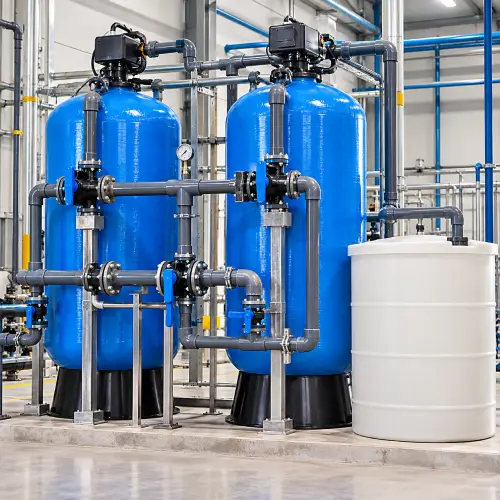
The pressure vessel houses the ion-exchange resin through which the hard water passes. Vessel dimensions and resin quantity are selected according to the required treatment capacity.
- Cation Exchange Resin
The resin is the primary treatment medium responsible for exchanging hardness-producing calcium and magnesium ions. Resin selection depends on water characteristics and operating conditions.
- Brine Tank
The brine tank stores and prepares the salt solution required during resin regeneration.
- Regeneration Arrangement
After the resin reaches its hardness-loading capacity, a regeneration cycle restores its ion-exchange capability. The regeneration sequence can include brining, slow rinse, fast rinse and service restoration stages.
- Control Valve
Manual, semi-automatic or automatic control arrangements can be provided depending on the operational requirements of the plant.
Why Industrial Plants Use Water Softeners
Installing a suitable softening system can help control problems associated with hard water, particularly in applications involving heating or repeated water circulation.
Potential operational advantages include:
- Helps reduce hardness-related scale formation
- Supports better heat-transfer performance
- Helps protect boilers and heat exchangers
- Reduces mineral deposits in pipelines and equipment
- Supports more consistent process-water quality
- Can reduce maintenance associated with hard-water deposits
- Helps improve the performance of downstream water-treatment equipment
- Provides a controlled source of softened water for industrial utilities
The actual performance depends on incoming-water quality, plant design, operating conditions and proper regeneration.
Water Softening Plants Built for Different Capacities
DSP Equipment can develop softening plants for different industrial water requirements, from relatively compact utility installations to larger systems serving multiple plant sections.
Typical Technical Parameters
Parameter | Typical Configuration |
Treatment Principle | Ion Exchange |
Primary Hardness Removed | Calcium & Magnesium |
Treatment Media | Cation Exchange Resin |
Vessel Construction | FRP / MS / Other Suitable Construction |
Regeneration Medium | Salt / Brine Solution |
Operating Mode | Manual / Semi-Automatic / Automatic |
Installation | Skid-Mounted or Site-Based |
Flow Capacity | Application Specific |
Resin Quantity | Based on Hardness Load |
Control Arrangement | Manual Valve / Automatic Valve |
Brine Storage | Dedicated Brine Tank |
Water Quality | Based on Feed-Water Analysis |
Final plant specifications are determined after evaluating water analysis, required capacity and site conditions.
Where Our Water Softening Plants Can Be Used
Water softeners are useful wherever hardness needs to be controlled before water enters a process or utility system.
Typical applications include:
- Boiler feed-water pretreatment
- Cooling tower make-up water
- Heat exchanger systems
- Process industries
- Manufacturing plants
- Pharmaceutical and allied industries
- Textile processing
- Food and beverage facilities
- Hotels and commercial establishments
- Laundry operations
- Engineering industries
- Chemical plants
- Industrial cleaning systems
- General utility-water treatment
Designed for Easier Operation and Maintenance
A well-planned softening plant should not only provide treated water but also allow operators to manage regeneration and routine maintenance conveniently.
DSP Equipment considers accessibility for:
- Resin inspection
- Valve servicing
- Brine preparation
- Salt replenishment
- Backwashing and rinsing
- Pipeline inspection
- Pressure monitoring
- Routine plant cleaning
Automatic configurations can further reduce the amount of manual intervention required during regular operating cycles.
Engineered Around Your Water Quality
There is no single softener configuration suitable for every industrial installation. DSP Equipment considers the characteristics of the incoming water before determining the plant arrangement.
Important design considerations include:
- Raw-water hardness
- Required softened-water capacity
- Peak and average flow
- Daily water consumption
- Regeneration frequency
- Resin loading
- Salt requirement
- Operating pressure
- Available installation space
- Required degree of automation
This application-based approach helps create a water softening system that is practical for both continuous and intermittent industrial operations.
Serving Industrial Water-Treatment Requirements across Eastern and Central India
DSP Equipment supports industrial requirements for Water Softening Plants in Kolkata, Bihar, Jharkhand, Odisha, Chhattisgarh and Assam. Our solutions can be adapted to different feed-water conditions and production requirements rather than relying on a fixed standard plant design. For a new installation, replacement of an existing softener or expansion of an industrial water-treatment facility, the system can be configured around the project’s actual flow and hardness load.
Discuss Your Water Softening Requirement with DSP Equipment
Choosing a softening plant should begin with understanding the raw-water condition and the purpose for which softened water will be used. DSP Equipment can develop an appropriate system based on water hardness, required capacity, regeneration requirements and plant operating conditions. If you need a Water Softening Plant Manufacturer in Kolkata, Bihar, Jharkhand, Odisha, Chhattisgarh or Assam, contact DSP Equipment for a project-specific solution and quotation.