
Fire Fighting Systems Manufacturer
Product Profile
Fire Fighting Systems are engineered arrangements used to detect, control and suppress fires in industrial, commercial and infrastructure facilities. A complete system may combine fire water pumps, hydrant networks, sprinklers, hose reels, valves, piping, fire water storage and other firefighting equipment according to the hazards present at the site.
DSP Equipment provides fire fighting system solutions for facilities that require coordinated firefighting infrastructure. The system configuration can be developed according to the building layout, fire load, water availability, protected area and applicable fire-safety requirements.
Key Features of Fire Fighting Systems
- Dedicated Fire Water Network for distributing water to designated firefighting points.
- Fire Pump Assemblies to provide the required pressure and flow.
- Hydrant Arrangements for delivering firefighting water across protected areas.
- Automatic Sprinkler Systems for suitable buildings and fire-risk zones.
- Hose Reel Installations for accessible first-response firefighting.
- Pressure Regulation Components for maintaining appropriate system conditions.
- Isolation & Control Valves for managing different sections of the network.
- Fire Water Storage sized according to the system requirement.
- Alarm & Monitoring Integration where required by the project design.
How a Fire Fighting System Supports Plant Safety
A fire fighting installation creates a planned method for delivering firefighting resources to areas where a fire may occur. Water stored in a dedicated tank can be supplied through pumps and distributed through a network of appropriately sized pipes to hydrants, hose reels or sprinkler systems.
The arrangement should be designed around the identified fire hazards rather than simply installing the same equipment throughout a facility. Warehouses, manufacturing units, electrical rooms and chemical-processing areas may require different protection strategies.
Fire Pump & Water Distribution Arrangement
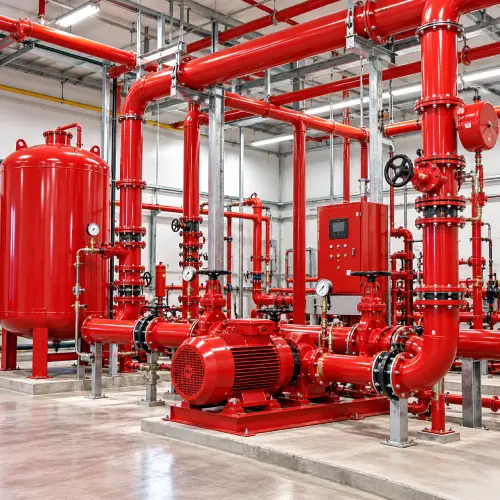
The fire pump assembly is an important part of a water-based firefighting network. Depending on the project, the pump room may incorporate suitable main pumps, standby arrangements, jockey pumps, controllers, valves and associated instrumentation.
The distribution network can include:
- Fire water storage tank
- Pump suction and discharge piping
- Main fire header
- Hydrant risers
- Landing valves
- Hose reels
- Branch connections
- Sprinkler piping
- Pressure gauges
- Control and isolation valves
Pump capacity, pressure and pipe sizing should be established through appropriate hydraulic calculations for the specific installation.
Engineering Components for Reliable Operation
The performance of a fire fighting system depends on the coordination of its individual components. Pipework must be appropriately supported, valves should remain accessible and pumps need suitable installation conditions.
Important engineering considerations include:
- Correct pipe diameter and pressure rating
- Suitable pipe supports and hangers
- Proper pump-room arrangement
- Accessible valve locations
- Adequate water storage
- Appropriate drainage provisions
- Clear identification of firefighting equipment
- Suitable inspection and testing access
All equipment should be selected and installed according to the applicable project specifications, fire-safety requirements and relevant standards.
Types of Fire Fighting Systems
Depending on the facility and identified hazards, firefighting infrastructure may include different system types.
- Hydrant Fire Fighting System
Uses a pressurised water network connected to hydrants and hose equipment for manual firefighting response.
- Automatic Sprinkler System
Uses heat-responsive sprinkler heads to discharge water when the operating condition of an individual sprinkler is reached.
- Hose Reel System
Provides a readily accessible water discharge point for responding to suitable fire incidents.
- Water Spray System
Designed for specific hazards where a controlled water spray is required for protection or cooling.
- Foam Fire Fighting System
Used for selected flammable-liquid hazards where foam is an appropriate extinguishing medium.
- Specialised Suppression Systems
Certain electrical, process or sensitive equipment areas may require alternative suppression technologies rather than conventional water discharge.
Applications Across Industrial & Commercial Facilities
Fire fighting systems can be planned for various types of facilities, including:
- Manufacturing plants
- Warehouses and distribution centres
- Power and utility facilities
- Steel and engineering industries
- Chemical and process plants
- Oil and fuel handling areas
- Commercial buildings
- Hotels and institutional facilities
- Shopping and storage complexes
- Large industrial infrastructure
The final protection method should be selected after assessing the materials, processes, occupancy and potential fire scenarios within each area.
Fire Fighting System Design Considerations
A properly planned installation begins with understanding the facility. Key inputs may include:
- Building Layout: Determines the protected zones and equipment locations.
- Fire Risk: Identifies the type and intensity of fire hazards expected.
- Water Availability: Establishes the requirements for storage and pumping arrangements.
- Coverage Area: Influences hydrant, sprinkler and hose-reel distribution.
- Operating Pressure: Helps determine pump and piping requirements.
- Future Expansion: Allows additional protection zones to be considered during initial planning.
Why Choose DSP Equipment?
DSP Equipment approaches firefighting projects from the perspective of the complete system rather than treating individual components as separate installations.
The project can be evaluated based on:
- Type of facility and industrial activity
- Fire-risk areas
- Required firefighting coverage
- Available water source
- Pumping requirements
- Piping routes
- Equipment-room space
- Maintenance accessibility
- Applicable fire-safety standards
This helps establish a coordinated equipment arrangement suited to the facility’s operational requirements.
Maintenance and System Readiness
A fire fighting system needs regular inspection and testing to remain ready for emergency use. Fire pumps, valves, hydrants, hose reels, sprinkler components, alarm interfaces and associated equipment should be checked according to the applicable maintenance schedule.
Water storage levels and pump operation should also be monitored. Any leakage, pressure abnormality, damaged component or inaccessible valve should be addressed promptly by qualified personnel.
Frequently Asked Questions
Depending on the project, it may include fire pumps, water tanks, hydrants, sprinklers, hose reels, piping, valves, controllers and related firefighting equipment.
Hydrant systems are commonly used in industrial facilities, but the required arrangement depends on the site's fire hazards, layout and applicable requirements.
Yes. Existing buildings can be assessed for available space, water supply, fire hazards and current infrastructure before developing an appropriate system.
No. Protection requirements vary according to occupancy, fire load, processes, stored materials and building characteristics.
A dedicated storage arrangement can provide the required quantity of firefighting water when the normal water supply cannot reliably meet the system demand.
Industrial Fire Fighting Solutions
A dependable firefighting installation requires coordination between water storage, pumps, distribution piping and final firefighting points. The design should also provide sufficient access for inspection, testing and maintenance throughout the service life of the equipment.
DSP Equipment can evaluate the requirements of an industrial or commercial facility and develop a suitable fire fighting system configuration based on the identified hazards, protected area and project specifications. For a project enquiry, provide the facility type, building area, number of floors, available water source, fire-risk details and site layout so the required firefighting arrangement can be assessed accurately.